Description: This applies only to single screw pumps (PCP, positive displacement type)
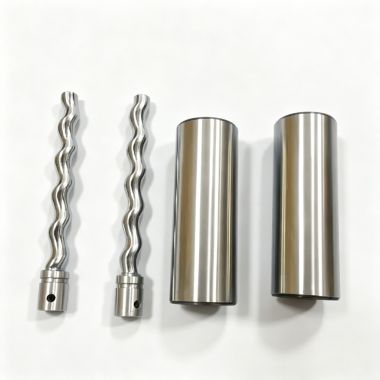
1) The outer steel sleeve and the inner elastic lining are bonded into one piece by high-temperature vulcanization.
The bore is a double-helical cavity that is interference-fitted with the single-helix metal rotor making it the number one wear-prone part of a single screw pump.2) Function
1. Forming a sealed conveying chamber: The rotor planetary eccentric rotation inside the stator.
Generating continuous sealed cavities along the axial direction and the medium is pushed from the suction port to the discharge port for pulsation-free conveying.
Sealing to maintain volumetric efficiency: The rubber lining relies on its elasticity to maintain an interference fit with the rotor and suppress internal backflow of the medium.
Stator damage directly shows up as a drop in flow rate and output pressure. Withstands alternating compression, friction, and corrosive erosion by the medium.
The number of stages (single-stage two-stage or four-stage) determines the rated output pressure of the pump: single-stage ≈ 6MPa.
Two-stage ≈ 2MPa and the more stages the longer the stator.3) Classification1) By Lining Material (Most Common)① Rubber elastic stator (used in the vast majority of installations) Elastic rubber is vulcanized inside the steel cylinder.
Sealing relies on the elasticity of the rubber, making it for sludge, slurry, and chemical materials. NBR (nitrile butadiene rubber): General-purpose and cost-effective, with good oil resistance.
For wastewater and oily sludge; not resistant to strong solvents or high temperatures, with a long-term limit of ≤80–100°C.
EPDM (ethylene propylene diene monomer): Resistant to hot water, steam, weak acids and alkalis, and for food applications.
Not resistant to mineral oil; 30–120°C. HNBR (hydrogenated nitrile butadiene rubber): A modified NBR with better heat-oil and wear resistance.
For oilfields and high-temperature oily media; 20–130°C.
FKM fluororubber: Resistant to strong solvents, acids, alkalis, and high temperatures; high cost; 20–180°C; relatively low elasticity.
PU (polyurethane): The best abrasion resistance, for slurries containing sand and particles; not resistant to hot-water hydrolysis.
≤80°C.② Rigid stator (metal or PTFE lining for special working conditions) With no rubber lining it is used for strong solvents.
Ultra-high temperatures and conditions in which rubber would swell and fail; sealing relies on precision clearances.
So volumetric efficiency is lower than that of a rubber stator and the cost is very high.2) By Screw Pair Combination.
Single-helix rotor with double-helix stator: the most widely used combination in industry. Multi-helix rotor with multi-helix stator: Rare in high-flow.
Low-pressure models.3) By Pressure Stage Single-stage two-stage and four-stage; the higher the number of stages the higher the permissible output pressure.
And the longer the stator.4) Problems (Fault Symptoms)
1. Inner wall wear: The clearance increases the flow rate drops.
The rated pressure cannot be reached internal backflow increases and the temperature of the medium rises. Rubber swelling and stickiness: The rubber absorbs the medium and swells.
The motor current surges and, in severe cases, the rotor seizes; this is a typical sign of incompatibility between the material and the medium.
Hardening, cracking, and chipping: Overheating and dry running cause aging; the rubber loses its elasticity and cracks appear, and rubber debris is carried out with the discharge.
Debonding (rubber separating from the steel cylinder): The vulcanized bond fails; the rubber bulges locally, the pump pressure fluctuates, abnormal noise occurs, and efficiency falls off a cliff.
Localized one-sided wear: Rapid wear on one side of the stator bore; usually caused by universal joint damage, rotor eccentricity, or poor installation alignment.
Burned black spots: Dry running (without medium lubrication or cooling) causes localized high-temperature charring of the rubber.5) Causes of Damage
1. Chemical incompatibility (swelling or corrosion): Incorrect rubber selection.
For example using EPDM for mineral oil or NBR for ketone solvents causes the rubber to absorb the liquid swell soften.
And degrade and is a frequent cause of early failure. Dry running or idling: Loss of material at the inlet means there is no medium for lubrication and cooling.
This can cause high-temperature burning and cracking of the rubber within a short time and is extremely destructive.
Abrasion by solid particles: The medium contains sand metal debris and hard impurities that continuously cut into the rubber lining and accelerate wear.
Excessive temperature: Being above the permissible temperature of the rubber for a long time accelerates thermal aging.
Hardening and cracking of the rubber. Overpressure operation: When the outlet pressure exceeds the design pressure differential of the stator.
The rubber is overloaded by alternating stress leading to fatigue cracking and debonding. Full-pressure operation is strictly prohibited for media with a high solids content.
Uneven wear caused by mechanical failure: A damaged universal joint pin a bent rotor or poor installation alignment makes the rotor strike the stator bore eccentrically.
Causing rapid localized wear. Manufacturing process defects: Insufficient or excessive vulcanization of the rubber or poor treatment of the steel cylinder bonding surface causes the rubber to peel off after operation.6) Brief Operation and Maintenance s.
When a stator fails, check the rotor for wear at the same time; scratches and plating loss on the rotor will in turn accelerate damage to the new stator.
The rubber stator must be kept from running dry; it is recommended to prime the pump with liquid before starting and stopping.
Three key factors in spare parts selection: rubber material number of stages and interference fit specification all of which must match the original pump.



 Contact Us