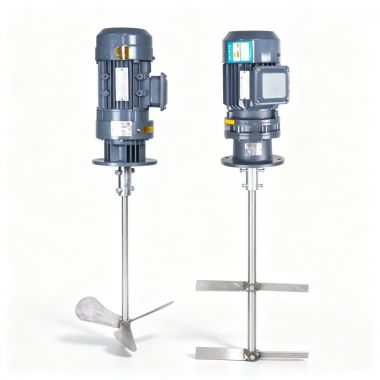


Description: A mixer is a device that forces convection and uniform mixing of liquid or gaseous media. It is widely used in chemicals, laboratories, food, and construction. Through a rotating impeller it applies shear, convection, and diffusion forces to the material to achieve mixing, dispersion, homogenization, or dissolution.
Classified by Application Scenario
Industrial mixers: Used in chemical, pharmaceutical, and food production lines with large processing capacity, and usually equipped with a reducer and a complex control system.
Laboratory mixers: Used for scientific experiments, such as magnetic stirrers and electric stirrers; small in size with precise speed control.
Household blenders: Common in kitchens for mixing batter, juice, and the like; low power and easy to operate.
Classified by Structural Form
Vertical mixer: The mixing shaft is inserted vertically into the vessel; suitable for high-viscosity materials or large-volume solutions.
Horizontal mixer: The mixing shaft is arranged horizontally; suitable for large industrial production lines, with a high degree of mixing uniformity.
Magnetic stirrer: Magnetic coupling drives the stir bar inside the vessel, eliminating the risk of shaft seal leakage; suitable for sealed vessels.
Classified by Impeller Type
Propeller type: Suitable for rapid mixing of low-viscosity liquids.
Turbine type: Strong shear force, favorable for gas dispersion and liquid-liquid reactions.
Anchor or frame type: The blades are close to the tank wall; suitable for scraped-wall mixing of high-viscosity fluids.
Helical ribbon type: Specifically for high-viscosity liquids and pseudoplastic fluids.
Selection should take into account both the process objective and the material characteristics. The main steps are as follows:
Determine the mixing objective: Such as liquid-liquid mixing, solid-liquid suspension, gas-liquid dispersion, heat transfer, or dissolution.
Analyze the material properties: Consider viscosity, density, corrosiveness, and whether it is flammable or explosive.
Select the mixer type: For low viscosity, choose a propeller or turbine type; for high viscosity, choose an anchor or helical ribbon type.
Calculate the power and speed: Calculate the mixing power by formula and select a motor power greater than 1.5 times the calculated value.
Starch mixers are dedicated mixing equipment used on starch processing lines for slurry preparation, mixing, reaction, and gelatinization. They are designed for the characteristics of starch liquor, namely "easy settling, a wide viscosity range, and the need for precise temperature control". High-torque drive and a suitable impeller keep the starch milk uniformly suspended and prevent settling and caking, while jacket temperature control ensures batch-to-batch consistency. The main body is food-grade SUS304/316L, mirror-polished and CIP-compatible, with customizable volumes from 0.5 to 30 m³.
Slurry preparation/washing → pitched-blade impeller or turbine impeller (medium to high speed); modification reaction → frame impeller (medium to low speed); gelatinization/liquefaction → anchor or helical ribbon impeller (low speed, high torque); pre-gelatinization dispersion → high-shear dispersion disc. A combination of high-speed slurry preparation and low-speed gelatinization is commonly used on the same production line.

 Contact Us