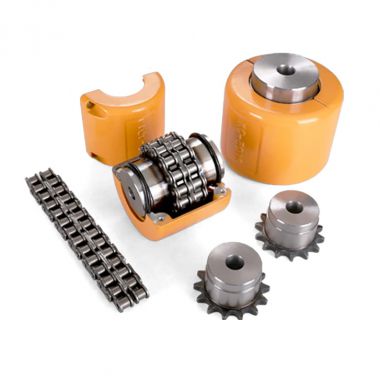


Description: A roller chain coupling is a mechanical transmission component that transmits torque by means of a double-row roller chain meshing simultaneously with two sprockets of equal tooth count. It is mainly divided into two types: the national standard GL series and the Japanese-style KC series.
And working principleCore components: A roller chain coupling is normally composed of two toothed half-couplings (sprockets).
One double-row roller chain and an optional protective cover.
Half-couplings: The mainstream material is 45# steel with quenching and tempering the gear teeth are high-frequency quenched.
And the standard bore supports a parallel key or a shrink disc connection.
Chain: The GL type uses a national-standard chain (such as a 16A double-row chain with a pitch of 4mm) while the KC type uses an American-standard chain (such as a 50 double-row chain with a pitch of 875mm).
Protective cover: A split aluminum alloy housing with a built-in O-ring seal, mandatory for high-speed operation.
Transmission mechanism: The driving sprocket drives the driven sprocket through the meshing of the double-row roller chain to rigid synchronous transmission.
While installation misalignment is compensated by the clearance of the chain joints. Radial misalignment compensation: ≤0.5mm (through lateral chain swing).
Axial misalignment compensation: ≤3mm (through the chain take-up allowance). Angular misalignment compensation: ≤1° (through the self-adjusting fit of the chain and sprocket teeth).
Applicable Conditions. Shaft drives for machinery in textiles, agricultural machinery, hoisting and conveying, mining, light industry, and chemicals.
High-temperature, humid, and dusty environments (-20°C to +120°C). Small and medium-sized belt conveyors, fans, water pumps, mixing equipment, and packaging machinery.
Unsuitable Applications. Not for high-speed operation, severe impact loads, or frequent reversal. For equipment that frequently stalls or jams, such as elevators and feeders, a safety coupling should be used.
Applications requiring zero-backlash precision transmission or the transmission of axial force.

 Contact Us