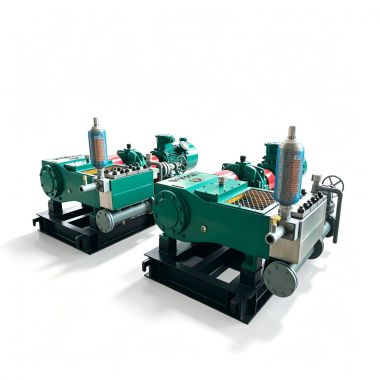


Description: Key equipment for feeding materials into the hydrogenation reactor for the production of sorbitol and maltitol.
The reactor feed pump is mainly a high-pressure plunger pump. Suction stroke: the plunger retracts, the pump chamber volume increases and negative pressure forms, the suction check valve opens, and fluid enters the cylinder. Discharge stroke: the plunger advances, the volume decreases and the fluid is pressurized, the suction valve closes and the discharge valve opens, and high-pressure liquid is delivered. The cycle then repeats. Multiple plungers (commonly three) are arranged with staggered phases to reduce flow pulsation. Key points: The flow rate depends basically only on the rotational speed and the plunger stroke; the output pressure is determined by the system load rather than being a fixed value of the pump itself, so a very high pressure can be delivered as long as the structural strength and motor power are sufficient.
High pressure makes it the first choice for high-pressure and ultra-high-pressure working conditions;
High volumetric efficiency (90%-95%), saving energy under high-pressure conditions;
The flow rate is easy to adjust, and a variable-displacement pump can change its output as required;
Good self-priming ability; suitable for high viscosity media;
The multi-cylinder structure can reduce flow pulsation.
It has very high requirements for medium cleanliness, and even tiny impurities will scratch the plunger and seals;
It has a precise structure, high manufacturing cost, and is difficult to maintain;
Single-plunger flow pulsation and vibration noise are large (multi-plunger improves this).
Seals are wear-prone parts and require regular maintenance and replacement.

 Contact Us