Description: Other names: Inlet dust filter and inlet filter element. Dry screw pumps have no oil mist separation, so the inlet filter is the core protective component at the front end of the pump.
Function
1. Solid particle interception: Filters out dust welding slag metal debris and powder particles in the process gas.
Stop hard particles from entering the pump cavity and scratching the screw rotor and timing gears thereby reduce rotor jamming.
Protection of the precision clearances of the pump: The clearance between the rotor and the housing of a dry screw pump is extremely small.
Tiny abrasive particles will permanently increase the clearance, causing a drop in pumping speed and ultimate vacuum.
The inlet filter is the first line of protection. Primary gas-liquid separation for some structures: Intercepts large droplets and process condensate.
The entry of water vapor and condensable substances into the pump that would cause scaling and coking. Inlet pressure differential monitoring: A differential pressure gauge or transmitter is configured to determine the blockage status of the filter element and to stop excessive inlet resistance and motor overload tripping caused by a blocked filter element.
Materials Filter Element Body
1. Polyester nonwoven fabric (PET): For general working conditions; moisture-resistant and with a large dust holding capacity.
Can be lightly purged, but is not resistant to high temperature or strong solvent corrosion.
Commonly used in chemical, lithium battery, and powder processes. Wood pulp composite filter paper: High filtration accuracy, for clean and dry working conditions.
It softens and breaks down easily when exposed to moisture and cannot be washed, so it is mostly used in clean workshops.
Stainless steel woven mesh/stainless steel sintered mesh (304/316L): Resistant to high temperature and chemical corrosion.
And washable for reuse; for high-dust and corrosive-steam working conditions, but with a relatively high cost.
Support frame: Galvanized steel plate or stainless steel perforated plate stop the filter media from collapsing under negative pressure.
Seals: NBR nitrile rubber and FKM fluororubber for end face sealing, stop gas short-circuiting and bypassing. Filter Housing.
Small sizes: cast aluminum.
Large sizes: painted carbon steel or a 304 stainless steel cylinder; flange or quick-release clamp structure; some models are fitted with a dust collection hopper and a liquid/sewage drain outlet.
Classification
1. By Installation Method. Built-in filter screen at the pump inlet: A simple metal screen inside the pump inlet provides coarse filtration and blocks only large particles.
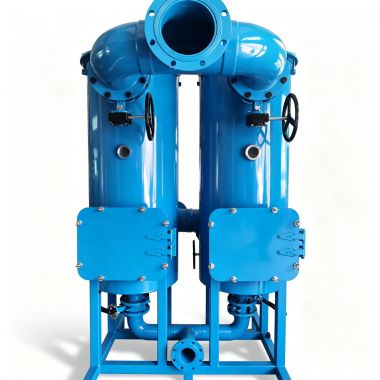
So it cannot serve as the main process filter. External cylindrical inlet filter: Flange-mounted at the front end of the pump inlet, this is the industrial mainstream.
It is divided into single-stage filtration and two-stage filtration with cyclone pre-separation plus a filter element.
The cyclone first settles large particles, the service life of the filter element. By filter element structure: pleated filter element, cylindrical sintered filter element, and metal mesh cylinder.
By maintenance method: Disposable replacement type washable and reusable type (metal sintered) and pulse backflushing self-cleaning type (for high-dust working conditions).
By configuration: With differential pressure monitoring without differential pressure monitoring and with a condensate drain outlet.
Problems
1. Filter blockage: Increased inlet pressure differential decreased pumping speed worse ultimate vacuum.
Increased motor operating current and higher pump temperature. Filter element damage, perforation, and collapse: The filter media is torn and dust penetrates directly into the pump chamber.
Bypass leakage: Damaged or improperly assembled seals allow gas containing impurities to enter the pump directly without passing through the filter media.
Gelling and scaling on the filter media surface: Condensable organic matter condenses and adheres, sealing the pores.
Liquid collection in the housing: Condensate accumulates and flows back to the process side or soaks the filter element.
Causes of Damage or Failure
1. Excessive dust accumulation and clogging (most common): The process dust load is high.
Exceeding the dust holding capacity of the filter element; after long-term neglect of maintenance the pressure differential keeps rising.
And the negative pressure collapses and tears the filter media allowing impurities to enter the pump body directly.
Which can seriously cause screw wear and seizure. Damage from condensable vapor and condensate: Solvent vapor and water vapor are drawn in and condense inside the filter element.
Paper and polyester filter media soften, blister, and perforate when exposed to moisture; and organic matter condenses into gum that plugs the filter pores.
Corrosion by chemical media: Drawing in acidic or alkaline corrosive gases corrodes the filter media stainless steel welds.
And rubber seals causing the filter media to become brittle and break and the seals to swell and leak. Pressure and negative pressure shock: Pressure fluctuations caused by system air inrush and valve switching.
Severe blockage creates extremely high negative pressure, deforming and collapsing the filter media support. Mismatched selection: The filtration rating selected is too coarse, allowing fine particles to pass through.
The material is not resistant to the process media; or the flow area of the filter element is too small, causing rapid clogging.
Assembly problems: Missing or misaligned sealing rings and inadequate tightening create a bypass; a misaligned filter element causes localized stress concentration.
Improper maintenance: Frequent high-pressure purging of disposable polyester or paper filter elements damages the fiber structure of the filter media and permanently reduces filtration accuracy.
Points of Operation and Maintenance Replace every 6–12 months under clean operating conditions and every 1–3 months under powder or condensable-material conditions.
Prioritize differential pressure alarms over fixed intervals; sintered metal filter elements can be washed and reused.
Two-stage cyclone filtration can significantly extend filter element life; periodically open the drain outlet to remove condensate.



 Contact Us