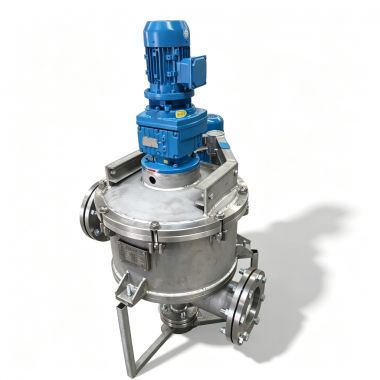


Description: Also known as a brush-type self-cleaning filter, this is an inline self-cleaning filtration device that uses a built-in rotating brush to scrape the screen mechanically, allowing continuous filtration with automatic brushing and blowdown without stopping the machine or removing the screen. It falls into two main categories: hand-cranked and fully automatic electric.
Cylinder body: 304/316 stainless steel or corrosion-protected carbon steel; fitted with water inlet, water outlet, and blowdown connections.
Filter screen: Wedge wire or stainless steel woven mesh, with a rating of 5-2000 μm; impurities are intercepted on the inner wall of the screen.
Rotating brush assembly: Central shaft + brush (nylon 66 soft brush or stainless steel wire brush), with the brush in close contact with the inner wall of the screen.
Drive: Hand crank (simple version) or motor + reducer (fully automatic).
Blowdown valve: Electric or solenoid valve, opened to discharge debris during cleaning.
Control system (fully automatic): PLC, differential pressure sensor, and timer; supports three modes — differential pressure trigger, timed trigger, and manual trigger.
Filtration stage: Raw water enters the housing and passes through the screen; suspended solids, silt, fibres, and algae larger than the mesh opening are trapped on the inside of the screen, while clean water flows out of the outlet. As impurities accumulate, the differential pressure between inlet and outlet gradually rises.
Brushing and blowdown stage: When the differential pressure reaches the set value, or the set time is reached, the control system activates:
The motor drives the central shaft and the brush rotates to scrape the inner wall of the screen, detaching the dirt;
At the same time the blowdown valve opens, and the detached impurities are discharged through the blowdown connection together with a small amount of water;
Flow continues throughout the whole process without interrupting the water supply.
Hand-cranked version: When the differential pressure rises, the external handle is turned by hand to drive the internal brush, and the blowdown valve is opened manually to discharge debris.
1. Inline cleaning means there is no need to stop the machine or remove the screen, making it suitable for 24-hour continuous operation;
2. Mechanical brush scraping is more effective than simple backwashing at removing sticky and fibrous impurities;
3. Fully automatic models can be controlled remotely, reducing manual maintenance;
4. Long screen life, with no need for frequent element replacement; only the worn brushes must be changed periodically;
5. Simple installation: Straight-through inline installation occupying little space.
1. Fine colloids and dissolved substances cannot be removed; it serves only as physical pretreatment;
2. For extremely fine sludge and heavily scaled conditions, even the brush may not clean thoroughly and chemical cleaning is required.
3. Fully automatic models have a motor and solenoid valves, so a few wear-prone parts require periodic maintenance.
4. Brushes wear down and flatten with prolonged use, so they must be inspected and replaced periodically.

 Contact Us