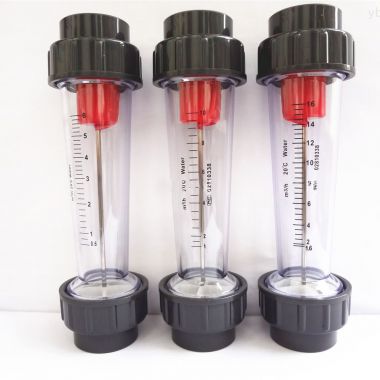


Description: Used in chemical, pharmaceutical, water treatment, air compressor gas, laboratory equipment, and analytical instrument applications to measure small and medium flow rates of clean media such as water, acid and alkali solutions, air, and nitrogen.
Made mainly of PVC and PP, it offers good corrosion resistance and is mostly used for water treatment and acid/alkali service, but its pressure and temperature ratings are relatively low.
1. Simple structure, high reliability, low maintenance, and low cost
2. Range ratio of 10:1, suitable for measuring small flow rates and low flow velocities.
3. Minimal requirements for upstream straight pipe sections, easy to install.
4. Pressure loss is small and essentially constant.
5. Both liquids and gases can be measured; the glass type allows direct on-site reading of the flow rate with no power supply required.
1. It must be installed vertically, with flow from bottom to top; tilting introduces significant error.
2. Only suitable for clean media; impurities can easily jam the float.
3. Measurement is affected by the density, viscosity, pressure, and temperature of the medium; gas measurement requires temperature and pressure correction.
4. Glass tubes are fragile; the diameter is generally small, and they are mostly used on pipe sizes of DN50 and below.
5. Accuracy: Class 2.5 for ordinary glass tubes, and approximately Class 1.5 for metal tubes.
1. Installation: Vertical, with flow entering at the bottom and leaving at the top; avoid vibration;
2. A pre-filter is required for dirty media, to prevent the float from jamming;
3. The nameplate scale is generally calibrated for a reference medium (water/air); measuring other media requires conversion and correction;
4. Gas measurement: Changes in operating pressure and temperature make the reading inaccurate and require compensation;
5. It cannot be used to measure media containing large amounts of particles or viscous media.

 Contact Us