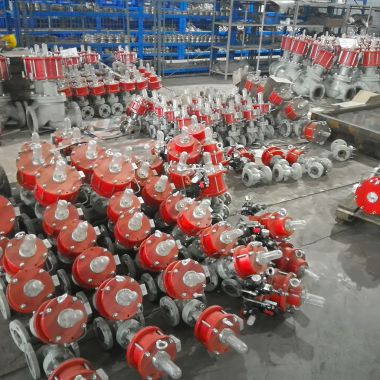


Description: PSA stands for Pressure Swing Adsorption, a process used for hydrogen production, nitrogen production, oxygen production, and CO₂ recovery. PSA valves generally refer to dedicated programmable valves for PSA systems, which are the core components of a PSA unit. They are switched at high frequency under PLC/DCS control to complete the sequential switching of adsorption, pressure equalization, forward release, reverse release, and purging.
Fast opening and closing: opening and closing time ≤ 0.5-3 s, matching a 90-180 s adsorption cycle;
Zero internal leakage: Class VI leakage; internal leakage directly reduces product purity;
Ultra-long cycle life: ≥ 500,000 to 1,000,000 switching cycles, with tens of thousands of cycles per day;
Two-way sealing: The pressure on both sides of the adsorption tower alternates between high and low, bearing pressure in both directions;
Dust erosion resistant: Resistant to abrasion from molecular sieve dust;
With valve position feedback: Remote valve position signal to confirm that the valve is actually in position;
Drive: Primarily pneumatic, with hydraulic drive for large diameters.
Programmable shut-off valves (lift valves): small and medium diameters DN15-DN150, soft PTFE seal, Class VI sealing, bidirectional sealing, dust resistant; widely used in nitrogen production and small-scale hydrogen production.
Triple-eccentric programmable butterfly valves: medium and large diameters of DN200 and above, for large-scale PSA hydrogen production units in petrochemical plants; mostly hydraulically actuated, with metal hard seals and high throughput.
Coaxial valve (shuttle valve): for small PSA nitrogen generators, with an integrated cylinder, extremely fast switching, and a compact structure.
Angle seat valves: Mostly used in small nitrogen production equipment; economical, and not suitable for large chemical PSA units.
PSA System Valve Functions
Inlet valve: Feed gas is switched to different adsorption towers;
Gas generation valve: Outputs qualified product gas (H₂/N₂/O₂);
Pressure equalization valve: balances pressure between towers and recovers pressure energy;
Forward discharge valve: Forward pressure relief;
Reverse release/purging valve: For desorption and regeneration, and exhaust gas discharge.
Internal leakage: The most common fault, caused by seal wear; symptoms are decreased product purity and abnormal tower pressure;
Slow or stuck operation: Actuator or solenoid valve malfunction, or dirty air supply;
Valve position feedback alarm: Limit switch damaged or offset;
External leakage: leakage from packing or flanges;
Dust particles wear down the sealing surface, accelerating its failure.
Diameter and pressure rating; explosion-proof requirements for the medium (hydrogen, nitrogen, etc.);
Opening and closing time, and valve position feedback is mandatory;
Class VI leakage;
Cycle life specification;
Drive: Pneumatic (small diameter) / Hydraulic (large diameter);
For media containing molecular sieve dust, models with anti-erosion structures are preferred.

 Contact Us