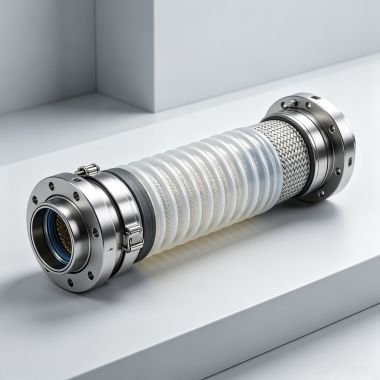


Description: Auxiliary flexible‑joint spare for desanding hydrocyclone banks. Deployed for compliant connections between feed distributor and hydrocyclone units and between hydrocyclones and overflow / underflow piping. Delivers vibration damping, thermal‑and‑assembly‑misalignment displacement compensation plus simplified disassembly‑assembly workflows. Essential auxiliary component for stable desanding‑equipment operation and reduced maintenance overhead.
1. Vibration & shock absorption: Absorbs pump‑induced mechanical vibration, feed‑pressure fluctuation impulses and piping water‑hammer loads. Eliminates rigid‑pipe stress‑fatigue and weld‑cracking risk. Also isolates vibration transmission to hydrocyclone bodies to preserve internal vortex‑field pressure stability and sustain desanding separation accuracy.
2. Compensate installation offset & thermal displacement: Flexible hose deformation absorbs on‑site assembly misalignment as well as piping thermal expansion‑contraction caused by process‑temperature shifts. It relaxes installation‑tolerance requirements and prevents sealing leakage and equipment structural stress originating from forced rigid‑pipe alignment.
3. Simplify disassembly, shorten maintenance downtime: For hydrocyclone, underflow‑nozzle or overflow‑pipe spare‑part replacement, only hose‑end couplings need disconnecting; no rigid‑main‑pipe cutting or re‑alignment required. Significantly shortens shutdown‑maintenance duration for continuous corn‑starch‑production‑line operation.
4. Reduce local wear & operational noise: Flexible construction buffers grit‑particle impingement at pipe‑run transition locations; also attenuates flow‑and‑equipment‑vibration‑derived noise to improve workshop operating environment.
For corn‑starch desanding service, steel‑wire‑reinforced food‑grade wear‑resistant rubber hose is the primary selection. Stainless‑steel corrugated metal hoses are specified for selected high‑temperature / high‑pressure special‑duty scenarios.
Multi‑layer composite rubber‑hose structure:
‑ Inner liner: Food‑grade wear‑resistant rubber; smooth non‑fouling surface complying with food‑contact safety criteria; withstands continuous fine‑sand slurry erosion.
‑ Reinforcement layer: Steel‑wire braided / wound reinforcement providing primary pressure‑containing capacity; prevents hose ballooning and shape‑distortion under working pressure.
‑ Outer cover: Aging‑resistant corrosion‑resistant rubber; protects inner construction against humid mildly‑corrosive plant‑site atmosphere.
Hose ends are normally fitted with 304‑stainless‑steel flanges or sanitary quick‑clamp couplings for precise mating with desanding‑equipment and piping interfaces; reliable sealing plus fast assembly‑disassembly.
Stainless‑steel metal hoses are assembled from corrugated tube, metal braid and end‑fittings; superior corrosion‑resistance and high‑temperature / pressure capability, but lower flexibility and higher procurement cost; reserved for severe‑service process sections.
1. Feed branch lines: Feed‑distributor outlet → individual hydrocyclone feed‑port. Most‑common location. One dedicated feed hose per hydrocyclone, supporting single‑unit isolation for inspection / overhaul.
2. Overflow branch lines: Hydrocyclone top overflow‑port → overflow‑header branch. Vibration‑isolation plus convenient overflow‑pipe removal for routine inspection and replacement.
3. Underflow branch lines: Hydrocyclone bottom underflow‑nozzle → underflow grit‑collection header. Tolerates high‑concentration grit‑laden slurry impingement; simplifies underflow‑nozzle disassembly‑cleaning‑replacement cycles.
4. Pump‑outlet main run: Installed between pump discharge and feed distributor; isolates pump‑body vibration to protect downstream distributor and complete hydrocyclone‑bank stability.

 Contact Us